Last updated July 15, 2026
Gate Repair Maintenance Checklist for Dallas Homeowners
The single maintenance step that prevents roughly 40% of emergency gate calls in Dallas costs nothing and takes 90 seconds — but you won’t find it on any manufacturer’s checklist, because manufacturers don’t know your soil. North Texas sits on some of the most expansive clay in the country, and that clay moves. It swells after a rain, contracts in a drought, and shifts with every freeze-thaw cycle that comes through in February. That movement doesn’t just crack driveways — it slowly tilts posts, strains hinges, and pulls gate operators out of alignment until one morning your gate simply won’t open. This checklist was built around what actually fails in Dallas, not what looks thorough on paper.
Quick Answer
A proper gate maintenance checklist for Dallas homeowners covers seven core areas: clay-soil post and hinge inspection, component-specific lubrication, battery backup testing, loop detector and photo-eye alignment, electrical and sensor checks, mechanical hardware review, and seasonal adjustments for North Texas heat and winter ice events. Completing this checklist twice a year — ideally in late March and late September — catches the vast majority of issues before they become emergency our Gate Repair services calls.
Table of Contents
- 1. Clay-Soil and Post Inspection: The Dallas-Specific First Step
- 2. Lubrication by Component: What to Use and When
- 3. Battery Backup Testing: Why August and October Matter Most
- 4. Loop Detector and Photo-Eye Inspection After Rain Events
- 5. Electrical, Control Board, and Sensor Checks
- 6. Mechanical Hardware and Structural Review
- 7. Seasonal Adjustments for North Texas Climate
- 8. Red Flag vs. Monitor It: The Decision Matrix
- Common Mistakes to Avoid
- When to Call a Professional
- Frequently Asked Questions
- The Bottom Line
1. Clay-Soil and Post Inspection: The Dallas-Specific First Step
Before you touch a single component on your gate, walk the post line. Dallas-area soil — particularly in neighborhoods like Lakewood, Preston Hollow, Plano, and most of the older Oak Cliff corridor — is dominated by the Austin Chalk and Eagle Ford shale formations sitting under thick expansive clay. When that clay swells after a spring rain or contracts during a July drought, it exerts lateral and vertical pressure that no gate post was designed to handle indefinitely.
Here’s the 90-second inspection we’re talking about: stand at the far end of your driveway and sight down the gate post line the way you’d sight down a pool cue. Any lean greater than 1–2 degrees is worth measuring and monitoring. Then crouch down and look at where the post meets the concrete pad or grade surface — you’re looking for gaps, heave cracks, or exposed anchor hardware that has lifted.
What to check during your soil-movement walkthrough:
- Post plumb: Use a level or post-hole plumb bob. More than 2 degrees out of vertical on a hinge post will eventually bind the gate and load the operator motor, shortening its life regardless of brand.
- Hinge stress marks: Look for paint cracks, rust streaks radiating from hinge bolt holes, or visible elongation of the bolt holes themselves — all are signs the hinge plate is working under abnormal stress from a shifting post.
- Foundation pad cracking: Small hairline cracks around the post base are common in Dallas clay; V-shaped cracks that are widening season to season are a red flag.
- Gate sag relative to the ground: Measure the gap between the bottom rail and the driveway surface at the latch end. A gap that has changed by more than half an inch since your last inspection means the post has moved.
In our experience with Dallas-area residential gates over the past 16 years, soil-related post lean is the root cause behind a significant share of operator burnout calls — particularly on FAAC and Viking swing-gate systems where the motor arm geometry is unforgiving of hinge misalignment.
2. Lubrication by Component: What to Use and When
One of the most damaging things a homeowner can do is grab a can of WD-40 and spray it on everything that moves. WD-40 is a solvent and water displacer — not a lubricant — and it actually strips the grease out of bearings over time. In Dallas summers that routinely hit 105°F, the wrong lubricant will thin out, drip off, and leave metal-on-metal contact within weeks.
Component-specific lubrication guide:
- Chain drives (LiftMaster, Linear, DoorKing): Use a white lithium grease or chain-specific gel lubricant. Apply every 6 months. In summer months, the heat accelerates evaporation, so check the chain’s sheen in August — a dry, dull chain in the Texas heat is a chain that’s wearing fast.
- Pivot bearings and hinge pins: Use a dry PTFE (Teflon-based) lubricant in summer — it won’t attract the dust and debris that a wet grease will in a Dallas wind event. In December and January, switch to a light penetrating oil that stays fluid at near-freezing temperatures.
- Rack-and-pinion gear sets (FAAC, BFT, Elite slide gate operators): Use the manufacturer-specified grease, typically a medium-weight lithium complex. Apply a thin, even coat along the full rack length. Avoid over-greasing — excess grease on a ground-level rack turns into a mud magnet after any DFW thunderstorm.
- Screw-drive operators (certain Ghost Controls and Mighty Mule models): Dry lubricant only. Grease on a screw drive attracts debris and causes the carriage to bind.
- Roller wheels on slide gates: Grease the roller axle, not the track surface. A greasy track collects leaves, gravel, and construction debris — all common on newer Dallas-area development lots.
- Control board enclosure hinges and latch: A small amount of silicone spray on the enclosure door seal keeps it from cracking and maintaining its weather resistance through temperature swings from 20°F to 108°F.
Lubrication frequency rule of thumb for Dallas: Twice a year minimum. If your gate gets 30 or more cycles daily — common in HOA communities like those in Frisco, Allen, or far-north Garland — increase to quarterly.
3. Battery Backup Testing: Why August and October Matter Most
Most gate maintenance guides tell you to test your battery backup every quarter. That’s a calendar-driven rule that ignores the actual risk pattern in North Texas. The two months that matter most in Dallas are August and October.
August is when sealed lead-acid batteries — the most common backup type in residential gate operators — are under maximum thermal stress. Prolonged heat above 95°F degrades battery capacity by accelerating the electrolyte evaporation inside sealed cells. A battery that tested fine in April may hold only 60% of its rated capacity by late August, which means a single power outage could leave your gate inoperable.
October is pre-storm-season prep. Dallas sees its highest frequency of unexpected ice events from late November through February. A battery that enters that window at partial capacity will fail the first time you need it most — when the power goes out during an ice storm and you’re stuck outside your property.
How to test your gate battery backup in 5 steps:
- Locate the backup battery in the operator housing — on most LiftMaster and BFT systems, it’s a sealed 12V or 24V lead-acid pack mounted in the control enclosure.
- Disconnect the AC power supply at the breaker or unplug the operator transformer — do not just flip the operator off at its internal switch.
- Run the gate through at least 10 full open-and-close cycles on battery power only. Count the cycles.
- If the gate slows noticeably, hesitates, or fails before completing 10 cycles, the battery is failing and should be replaced before storm season.
- Reconnect AC power and note the date — set a phone reminder for your next test in 6 months.
Most residential gate backup batteries have a useful life of 2–4 years. If yours is over 3 years old and you don’t know when it was last replaced, replace it before October. The cost of a new battery is a fraction of an emergency service call at midnight during an ice event.
4. Loop Detector and Photo-Eye Inspection After Rain Events
This is the section that separates a Dallas-built checklist from a generic one. In most parts of the country, loop detectors and photo-eye sensors are a set-and-forget component. In DFW, they are post-storm inspection items — every time.
Here’s why: Dallas clay soil moves measurably after significant rainfall. A 3-inch rain event — not unusual in April or May in Dallas — can shift the grade around your gate’s saw-cut loop detector slot by enough to change the loop’s sensitivity setting. The wire in the slot can develop micro-cracks from ground movement. And the grade wash from heavy runoff frequently deposits silt and debris directly on the photo-eye lens housings mounted at gate-base level.
Post-rain loop detector and photo-eye protocol:
- Visual grade check: After any rain over 1.5 inches, walk the driveway loop area and look for new surface cracks, settled spots, or areas where the asphalt or concrete has shifted relative to the loop slot edges. Cracked sealant around the slot is a humidity and water intrusion point.
- Loop sensitivity test: Drive a vehicle over the loop and observe operator response. The gate should detect the vehicle within 1–2 seconds. Sluggish response or missed detection after a rain event is a strong indicator the loop card’s sensitivity needs adjustment — or the loop itself has been damaged.
- Photo-eye alignment check: Wipe both the transmitter and receiver lenses with a dry cloth. Confirm the indicator LED on the receiver is solid (not blinking). If it’s blinking, the beam is broken — check for debris, mud, or grade-shifted mounting posts before calling for service.
- Check safety reverse: Block the photo-eye beam and attempt to close the gate. If the gate does not stop and reverse immediately, do not operate the gate and call a technician. A failed safety reverse is a liability and injury risk.
We regularly see loop detector failures in the weeks following major storms across Dallas — particularly in areas with newer construction where lot grading is still settling, such as parts of far-north Dallas and the Southlake corridor neighborhoods.
5. Electrical, Control Board, and Sensor Checks
Gate operators are outdoor electrical equipment exposed to 110°F attic-equivalent heat inside their enclosures in July and near-freezing temperatures in January. That thermal cycling stresses every connection point, terminal block, and component solder joint over time.
Electrical checklist items (biannual):
- Inspect the control enclosure seal: The weatherstripping or foam gasket on your operator’s control box lid should be intact and compressible. A dried-out seal allows humidity to condense on the control board — the leading cause of board corrosion failures on DoorKing and Elite systems we service in the Dallas area.
- Check all terminal block connections: Look for green oxidation (copper corrosion), discoloration from heat, or terminals that have worked loose from vibration. Loose connections cause intermittent fault codes that mimic motor or logic failures.
- Inspect the power transformer output: With a multimeter, verify the transformer is delivering the rated voltage listed on its label. Voltage drop of more than 10% warrants a transformer replacement.
- Review error codes: Every modern gate operator logs fault codes — LiftMaster, FAAC, and BFT systems all have LED blink sequences or display readouts. Pull those codes during your inspection. A code history tells you whether the system has been hunting for position, overloading on torque, or tripping on thermal protection repeatedly.
- Test all access control inputs: Keypads, card readers, and remote entry devices should actuate the gate cleanly. Sluggish or missed commands often trace to corroded antenna connections, not failed access control hardware.
6. Mechanical Hardware and Structural Review
The mechanical side of a gate system is often the last thing homeowners inspect and the first thing that causes a failure. This section covers the hardware that holds everything together — literally.
Mechanical hardware checklist:
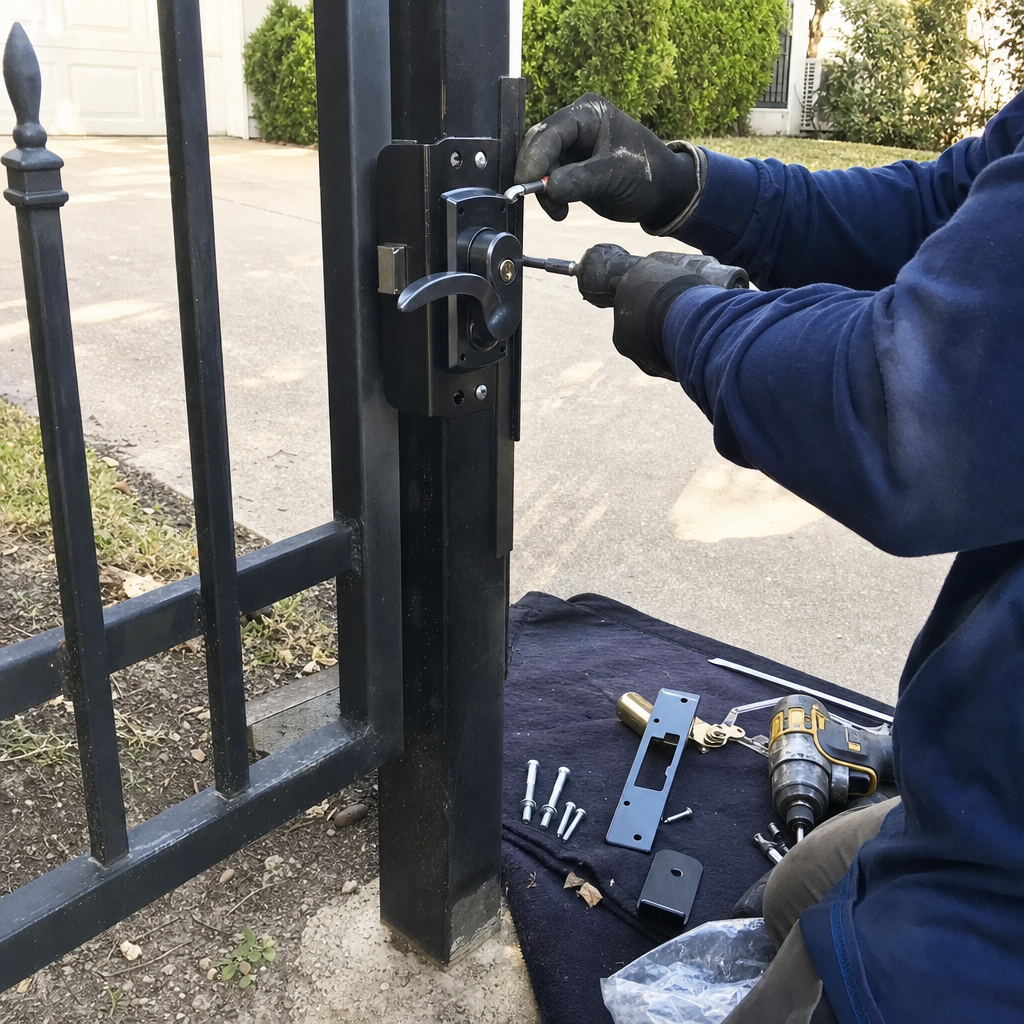
- Hinge bolt torque: Gate hinges work under constant cyclical load. Check that all hinge mounting bolts are tight — hand-tight is not enough. Use a wrench and verify. On steel post-mount hinges, look for any signs of the weld cracking at the post interface.
- Latch mechanism: Swing gates should latch fully and hold against a 20–30 lb lateral push. A latch that doesn’t seat properly puts the full closing force on the operator arm instead of the latch hardware — this will burn out operator motors faster than almost any other mechanical failure mode.
- Gate wheel track (slide gates): Remove any accumulated debris from the track channel. In Dallas, wind-blown gravel and construction dust from nearby development are constant track contaminants. A piece of gravel jammed under a carriage wheel will stall most operators hard enough to trigger overcurrent protection and trip the system offline.
- Operator arm connections: On swing gate operators — FAAC, BFT, and Linear are the most common in DFW residential installations — inspect the clevis pins and jam nuts at both the gate-side and post-side arm connections. These work loose over thousands of cycles and cause arm slap that damages the operator’s internal gearbox.
- Gate frame welds: Walk the full perimeter of the gate frame and inspect for cracks, particularly at mitered corners and where the picket or panel material meets the horizontal rails. A cracked weld that isn’t caught early will propagate and eventually require full frame section replacement.
Our in-house welding capability means that when we find a cracked weld or a broken bracket during a maintenance visit, we can repair or fabricate the part on the spot — no waiting a week for an outside metal shop to turn around a piece.
7. Seasonal Adjustments for North Texas Climate
Dallas doesn’t have four gentle seasons. It has summer, then a brief fall, then a cold snap that arrives fast, then a brutal spring. Your gate system needs to be adjusted accordingly.
Spring (March–April): Post-winter check
- Inspect for freeze-damage to photo-eye wiring conduit — PVC conduit cracks under the freeze-thaw cycle if it’s ground-mounted and was already aging.
- Re-check post plumb after the winter clay movement cycle — this is when you’ll catch shifts that the fall inspection couldn’t predict.
- Re-lubricate all pivot bearings and chain drives — winter condensation and any ice contact will have dried out or contaminated lubrication.
Summer (June–August): Heat management
- Check that the operator enclosure has no cracks or gaps that allow direct sun exposure on the control board — enclosure temps can exceed 140°F in direct Dallas sun.
- Test thermal shutdown behavior: most operators will pause and cool down if internal temps hit the limit. Know where your reset button is before you need it at 6 PM in August.
- Run the battery backup test described in Section 3 in August — this is the critical window.
Fall (September–October): Storm-season prep
- Run the full battery backup test protocol again.
- Confirm all photo-eyes and loop detectors are clear and aligned before the fall storm season picks up.
- Check enclosure weatherseal condition — a deteriorated seal heading into winter is a control board failure waiting to happen.
Winter (November–February): Freeze preparedness
- Verify your operator’s low-temperature operating rating. Most residential operators are rated to 0°F, but battery performance drops sharply below 20°F — common in Dallas during severe freezes like the ones in 2021 and 2023.
- If your gate has a ground-contact rubber seal or bottom wiper, confirm it won’t freeze to the driveway surface and create a mechanical bind that stalls the operator.
8. Red Flag vs. Monitor It: The Decision Matrix
Not every finding on this checklist demands an immediate call. Here’s how to triage what you find:
| Finding | Classification | Action |
|---|---|---|
| Gate fails safety-reverse test | Red Flag | Stop using gate. Call immediately. |
| Post lean greater than 3 degrees | Red Flag | Operator damage risk. Schedule within 2 weeks. |
| Battery fails 10-cycle test | Red Flag | Replace battery before next storm event. |
| Photo-eye blinking / beam broken | Red Flag | Stop using gate until resolved — safety issue. |
| Cracked frame weld | Red Flag | Schedule repair — crack will propagate under load. |
| Loose hinge bolt (1–2 bolts) | Monitor It | Tighten now, re-check in 30 days. |
| Post lean 1–2 degrees | Monitor It | Photograph, measure, and re-check in 90 days. |
| Minor surface rust on hinge plates | Monitor It | Wire-brush, treat with rust converter, re-paint. |
| Enclosure seal slightly compressed | Monitor It | Replace at next service — add to parts list. |
| Track debris (gravel, leaves) | Monitor It | Clear immediately — takes 5 minutes. |
| Loop response slightly slow after rain | Monitor It | Allow soil to dry, retest. Persists? Call for sensitivity adjustment. |
Common Mistakes to Avoid
- Using WD-40 as a lubricant on gate components. WD-40 strips bearing grease and evaporates quickly in Dallas heat, leaving components dry within days. Use component-specific lubricants as outlined in Section 2.
- Ignoring a slow gate and assuming it will work itself out. A gate that’s slowing down is an operator that’s working harder than it should — usually against a mechanical obstruction or misalignment. Left alone, that load will burn out the motor. In our 16 years working Dallas-area gates, “it was just slow for a few weeks” is the most common sentence before a complete operator replacement conversation.
- Testing the battery backup by turning off only the gate’s internal power switch. Most operators keep the battery on charge even when the gate’s switch is off. You must disconnect AC power at the breaker or unplug the transformer to genuinely test the backup system.
- Assuming post-rain sensor issues are a sensor failure. Dallas homeowners frequently replace photo-eye sets that are actually misaligned from soil movement — a $12 adjustment that got diagnosed as a $150 parts replacement. Always check alignment before assuming component failure.
- Over-lubricating the rack on a slide gate. Excess grease on a ground-level rack in a Dallas yard collects debris, hardens in summer heat, and can cause the pinion gear to skip under load. A thin, even coat is correct — more is not better.
- Deferring a cracked gate frame weld until it’s convenient. Weld cracks propagate under cyclical gate load. A crack that looks stable in October will often be a failed section by February after a freeze cycle. North Texas freeze-thaw, combined with heavy gate use, is a reliable accelerant.
- Running a single access control device and assuming the full system is working. If you only test entry with your remote, you may miss a failed keypad or a corroded card reader input that will strand a family member or delivery vehicle. Test every input device during your biannual check.
When to Call a Professional
Some findings on this checklist are homeowner-serviceable. Others require a technician who knows gate systems specifically — see How to Hire a Gate Repair Contractor in Dallas: A Step-by-Step Guide — not a general handyman making a guess at a FAAC logic board.
Call a gate specialist immediately if:
- Your gate fails the safety-reverse test — this is a liability and injury risk, not a maintenance item.
- The operator runs but the gate doesn’t move — this typically indicates a sheared drive key, stripped gear, or failed arm connection that requires disassembly.
- You’re seeing recurring fault codes that reset but return within days — a control board that’s logging repeated overcurrent or position-loss errors has an underlying mechanical cause that won’t self-correct.
- Any post has shifted more than 3 degrees — realignment requires concrete work and precise geometry that affects operator performance.
- There’s any burned smell, visible scorch marks, or wire insulation damage on or near the control enclosure — these are electrical faults, not deferred maintenance.
All Star Gate Repair Dallas offers free estimates on gate repair and maintenance calls throughout Dallas and surrounding areas. If you’re looking at a finding on this checklist and aren’t sure which column it falls in, call us at (940) 326-5404 — a 5-minute conversation with Jason can save you an expensive misdiagnosis.
Frequently Asked Questions
How often should I perform gate maintenance in Dallas?
Twice a year is the minimum for most Dallas residential gates — late March and late September hit the two critical transition points between the city’s punishing summer heat and its fast-moving winter ice season. Gates with 30 or more daily cycles (common in HOA-gated communities) should be serviced quarterly. Each service should include lubrication, hardware torque check, battery test, sensor alignment verification, and a soil-movement post inspection specific to DFW’s clay conditions.
What type of lubricant should I use on my gate in Dallas?
It depends on the component and the season. White lithium grease works well on chain drives. Dry PTFE lubricant is best for pivot bearings and hinges in summer, when wet lubricants attract dust and debris. Rack-and-pinion systems on slide gate operators like FAAC and BFT call for manufacturer-specified lithium complex grease applied in a thin coat. Never use WD-40 as a lubricant — it’s a solvent that will dry out bearings faster than leaving them unlubricated in a Dallas summer. Call (940) 326-5404 for an exact recommendation based on your specific system.
Why does my gate work fine most days but occasionally fail to open?
Intermittent failures on Dallas gates are most often caused by three things: a deteriorating battery backup that drops below operating voltage under load, a loop detector losing sensitivity after soil movement from rain, or a loose terminal connection on the control board that makes and breaks contact with temperature changes. None of these failures produce obvious symptoms until they reach a threshold — which is why they feel random. A technician with access to the operator’s fault code history can usually identify the cause in minutes rather than guessing at parts.
How does Dallas clay soil damage a gate system?
Expansive clay soil — which underlies most of the Dallas metroplex — swells when wet and contracts when dry. That seasonal movement exerts lateral and vertical pressure on gate posts, which shifts them out of plumb over time. A tilted hinge post puts the gate out of the plane the operator was calibrated for, which increases the torque load on the motor arm, stresses the hinge hardware, and eventually causes the operator to fault on overcurrent protection or burn out entirely. Catching post lean at 1–2 degrees is a monitoring situation. At 3 degrees or more, it’s an active operator-damage risk.
Can I test my gate’s safety reverse myself?
Yes — and you should, at every biannual maintenance check. For photo-eye safety reverse: block the beam with your hand or a piece of cardboard while the gate is closing. The gate must stop and reverse immediately. For contact-based reversing (on operators with a resistive safety edge): place a 2×4 flat on the ground in the gate’s path and close the gate — it must stop and reverse on contact. If it doesn’t, stop using the gate and call a specialist. A gate that doesn’t reverse on obstruction is a crush hazard, and this is the one finding on this checklist with zero tolerance for a “monitor it” response.
What gate brands do you service in Dallas?
Jason Robinson and the team at All Star Gate Repair Dallas are trained and experienced across nine brands: LiftMaster, FAAC, BFT, Linear, Viking, Ghost Controls, DoorKing, Elite, and Mighty Mule. Whether you’re running a commercial Gate Motor & Opener in Addison on a FAAC system or a residential Ghost Controls swing gate in a north Dallas neighborhood, the diagnostic approach is brand-specific — not a generic reset-and-hope. If your brand is on that list, we know its failure modes, its fault codes, and where it tends to wear first in Dallas conditions.
The Bottom Line
A Dallas gate maintenance checklist that ignores your soil, your climate, and your storm calendar isn’t a checklist — it’s a liability dressed up as advice. For more guides & resources, explore our blog. The checklist in this guide is built around what actually fails in North Texas: clay-driven post movement, heat-degraded batteries, rain-shifted sensors, and winter freezes that arrive before most homeowners think to prepare. Run this inspection in late March and late September, use the red-flag decision matrix to triage what you find, and you’ll head off the majority of emergency gate calls before they happen. When something lands in the red-flag column, get a specialist on it fast — gate specialists, not generalists.
Ready to schedule a professional maintenance check or get a second opinion on a finding from this checklist? Call All Star Gate Repair Dallas at (940) 326-5404 for a free estimate. We also offer Gate Repair in Addison and Gate Installation in Addison for property owners throughout the area — 343 customers and a 4.9-star average built on one specialty, done right.
Written by Jason Robinson, Owner & Lead Technician at All Star Gate Repair Dallas, serving Dallas since 2010.