Last updated July 15, 2026
How to Hire a Gate Repair Contractor in Dallas: A Step-by-Step Guide
Texas doesn’t require a state-issued license to work on gate operators. That single fact changes everything about how you should approach hiring someone to work on yours. In Dallas, the person quoting your FAAC motor repair may have passed zero certification exams, opened zero gate control boards before yours, and still arrive in a professional-looking truck with a confident handshake. This guide — alongside The Complete Guide to Gate Repair in Dallas — gives you a concrete, step-by-step screening process with specific questions, red flags, and reference checks so you can tell the difference between a genuine gate automation specialist and someone who watched a tutorial video last Tuesday.
Quick Answer
To hire a gate repair contractor in Dallas, verify general liability and inland marine insurance, confirm brand-specific experience with your operator (LiftMaster, FAAC, BFT, or whichever system you run), insist on a physical site visit before any quote, and ask for a line-itemized estimate — not a lump-sum “repair gate” figure. In a market with no state licensing requirement, these four steps do the filtering work that licensing laws do in other trades.
Table of Contents
- Why the Dallas Gate Repair Market Is Different From Other Trades
- The Right Insurance Questions to Ask — and Why Inland Marine Matters
- Brand Authorization vs. Brand Familiarity: They’re Not the Same Thing
- Why a Quote Without a Site Visit Is a Red Flag
- How to Read a Gate Repair Estimate
- Reference Verification Specific to Gate Work
- How Dallas Climate and Code Affect Your Gate System
- Common Mistakes to Avoid
- When to Call a Professional
- Frequently Asked Questions
- The Bottom Line
Why the Dallas Gate Repair Market Is Different From Other Trades
When you hire a licensed electrician or plumber in Dallas, the state licensing board has already run a baseline filter — there are exams, apprenticeship hours, and continuing education requirements before anyone can legally pull a permit. Gate automation exists in a different regulatory world. In Texas, installing or repairing a gate operator sits in an undefined zone between electrical work, fence construction, and low-voltage systems — and no single licensing body owns the category.
What that means practically: a general fence contractor, a handyman, and a 16-year gate automation specialist can all legally quote the same FAAC repair job. From the customer’s side of the conversation, they look similar. The fence contractor may have replaced one operator three years ago. The handyman may have done exactly that — watched a video and ordered a part. The specialist has opened that control board dozens of times and knows which firmware version causes the intermittent fault you’re describing.
Dallas also has a dense and growing market for automated gates — from the gated communities in Prosper and Frisco bleeding south into the city, to commercial properties along the Design District, to HOA-managed entrances across Preston Hollow and Lake Highlands. That volume of installed systems has attracted a wide range of contractors, not all of them equipped to service what they sell. The screening process in this guide is built specifically for this market reality.
The Right Insurance Questions to Ask — and Why Inland Marine Matters
General liability insurance is the minimum floor. Any contractor working on your property should carry it, and you should ask for a certificate of insurance — not just a verbal confirmation — before work begins. But for gate repair specifically, general liability alone has a coverage gap worth understanding.
General liability typically covers bodily injury and property damage that occurs during the work. What it often doesn’t cover is damage to the hardware the contractor is actively handling — your gate operator, your access control board, your intercom unit. If a technician drops a BFT motor during installation and damages it, or a control board is shorted during diagnostics, that loss may fall outside the general liability policy entirely.
Inland marine coverage — despite the nautical-sounding name — is the commercial policy that covers equipment and materials in transit or being worked on at a job site. It’s standard practice among established gate contractors and notably absent among less-experienced operators who haven’t thought through their liability exposure.
Ask this exact question: “Do you carry inland marine coverage for the hardware you’re handling on my property?” A contractor who knows their business will answer without hesitation. A contractor who has never heard the question asked may need to call their broker — which tells you something.
- Request a certificate of insurance naming general liability coverage with minimum $1 million per occurrence.
- Ask specifically whether inland marine or equipment coverage is included in their policy.
- Confirm the policy is current — certificates have expiration dates, and coverage lapses happen.
- For commercial properties in Dallas, ask whether their policy covers the scope of your site (multi-gate HOA entrances carry different risk profiles than a single residential driveway gate).
Brand Authorization vs. Brand Familiarity: They’re Not the Same Thing
When a contractor says “yeah, we work on LiftMaster,” that tells you almost nothing useful. LiftMaster has dozens of operator models spanning residential swing gates, commercial slide gates, and commercial barrier arms — each with different control board architectures, different programming procedures, and different authorized service protocols. “We work on it” and “we’re factory-authorized to program and warranty it” are not interchangeable claims.
Factory authorization matters for two reasons. First, some operators — particularly commercial-grade systems like DoorKing and FAAC — require dealer-level programming access that isn’t available to unaffiliated technicians. A contractor without that access may be able to replace physical components but cannot fully configure or test the system. Second, factory-authorized service typically preserves the manufacturer’s warranty on parts. An unauthorized repair on a Viking or Elite operator may void coverage you paid for when the system was installed.
Ask these questions directly:
- Which brands are you factory-authorized to service and warranty? Listen for specific brand names, not generalities.
- For my specific operator model, can you access dealer-level programming? This matters for DoorKing, FAAC, and BFT systems especially.
- How many times have you personally worked on this exact model? Experience on a Ghost Controls residential swing gate doesn’t transfer cleanly to a commercial FAAC barrier.
- If a part needs to be ordered, can you source it through an authorized distributor, or are you pulling from aftermarket supply? Aftermarket parts on branded operators can create warranty and compatibility problems.
At All Star Gate Repair Dallas, Jason Robinson has hands-on diagnostic experience across nine brands — LiftMaster, FAAC, BFT, Linear, Viking, Ghost Controls, DoorKing, Elite, and Mighty Mule — built over 16 years of exclusive gate work. That’s the benchmark you should be asking other contractors to meet.
Why a Quote Without a Site Visit Is a Red Flag
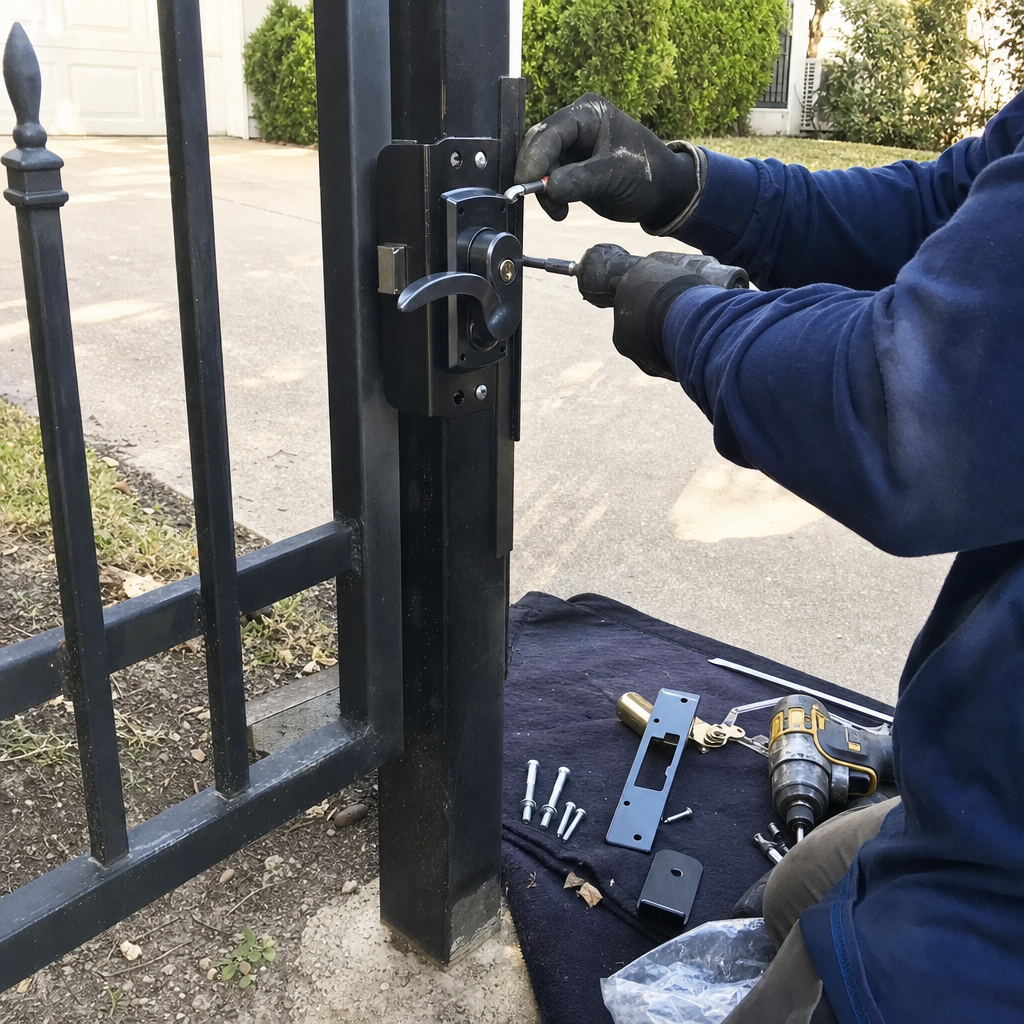
Legitimate gate diagnosis is not a phone call. It’s a physical inspection of three interconnected systems: the operator itself, the gate structure it’s moving, and the access control system managing when and how it opens. A contractor who quotes a repair without seeing all three is guessing — and structuring the quote to protect themselves when the guess turns out to be wrong.
Here’s what gets missed without a site visit:
- Structural issues masquerading as operator failures. A gate that repeatedly trips its motor limit may be doing so because the post has shifted a quarter inch — something invisible in a photo but obvious in person when you watch the gate travel its arc.
- Wiring condition. In Dallas, temperature cycles between January ice storms and August heat above 100°F stress low-voltage wiring conduit joints. Hairline cracks in insulation cause intermittent faults that look like operator failures. You can’t see this without physically tracing the wire run.
- Access control integration conflicts. A Mighty Mule residential operator behaves differently when it’s wired into an aftermarket keypad versus its native receiver. Diagnosing the behavior requires seeing how the system is actually wired, not how it was supposed to be wired.
- Gate weight and travel distance. These directly determine whether the current operator is correctly sized — and whether a “repair” is actually a misapplication that will fail again in six months.
If a contractor quotes you over the phone and pushes back when you ask for a site visit first, treat that as diagnostic information about the contractor.
How to Read a Gate Repair Estimate
The format of a repair estimate reveals how a contractor thinks about the work. A knowledgeable gate specialist writes estimates that separate labor from parts, identify the specific components being replaced or repaired, and describe what each line item is fixing and why. A less experienced contractor writes a quote that says “repair gate – $450” and moves on.
The lump-sum estimate protects the contractor. It gives them flexibility to define the scope of “repair” after the fact, charge for additional items they “discovered” during work, and provide no paper trail if the repair fails and you want to understand what was actually done. It gives you nothing.
Here’s what a well-structured gate repair estimate should include:
- Diagnostic/service call fee: Itemized separately from repair labor, with a clear note on whether it applies toward the repair total.
- Labor hours and rate: Estimated time on-site for the specific work described, not a blanket “labor” figure.
- Parts — by name and part number: “Control board replacement – LiftMaster K001A5873” tells you what you’re buying. “Part” tells you nothing.
- What the repair addresses: One sentence describing the diagnosed fault and how the work corrects it.
- Warranty terms: Separate warranty periods for labor and parts, stated explicitly. “90 days” means something. Verbal assurances mean nothing six months from now.
- Exclusions: Any related issues observed but not included in this quote — listed so there are no surprise charges after work starts.
When you receive a vague estimate, you’re not just getting an unclear price — you’re getting a preview of how disputes will be handled if something goes wrong.
Reference Verification Specific to Gate Work
Most contractors are happy to hand over references from satisfied customers. The problem is that a gate repair that looked fine at completion can fail within 90 days if the root cause wasn’t fully diagnosed — and a reference check conducted the week after the job won’t tell you that.
The right reference questions are time-shifted. You want to know how the repair held up after six months, not six days. Ask the contractor for references who had work done at least six months ago — ideally a full year. A contractor who has been operating in Dallas long enough to have a track record should be able to provide this without difficulty. One who can’t may not have completed enough jobs, or may have a pattern of callbacks they’d prefer you not know about.
When you reach past customers, ask these specific questions:
- “Has the same problem recurred since the repair?” This is the fundamental quality test. A gate that needed the same fix again within a year was likely patched, not fixed.
- “Did the contractor find anything during the job that wasn’t in the original quote, and how was it handled?” Change orders reveal how a contractor manages scope — and whether they use surprises as a revenue mechanism.
- “How did the contractor explain the problem to you?” A technician who can explain in plain English what failed and why demonstrates actual diagnosis, not parts swapping.
- “If the same problem came back tomorrow, would you call the same contractor?” The most honest answer you’ll get.
In our experience across 343 jobs in Dallas, the repairs that come back within a year almost always trace to one skipped step in the initial diagnosis — a structural misalignment left uncorrected, a wiring fault treated as an operator fault, an undersized motor reinstalled because it was cheaper to reuse. References reveal that pattern if you ask the right questions.
How Dallas Climate and Code Affect Your Gate System
Dallas sits in a climate zone that is genuinely hard on automated gate systems. Summers regularly push above 100°F, which stresses motor windings, degrades plastic gear components, and causes control boards to thermal-throttle — a fault condition that can look identical to a failing board but resolves when the unit cools down. Winters bring ice storm cycles, particularly in February, that seize hinges, freeze hydraulic operators, and stress aluminum slide gate track channels that have expanded and contracted through months of heat.
In neighborhoods like Oak Cliff and Pleasant Grove, we see a disproportionate number of calls for slide gate operator failures following freeze events — the gate structure shifts on ice-heaved ground, and the operator’s limit settings are suddenly wrong. That’s not a motor problem. That’s a site condition problem that requires adjustment, not replacement.
Dallas city code also has relevant requirements worth knowing before you hire:
- Entrapment protection: Dallas code aligns with UL 325 requirements for automated gates — operators must include entrapment protection devices (photo eyes, pressure-sensitive edges, or loop detectors depending on gate type). A contractor installing or replacing an operator without addressing entrapment protection is creating code liability for you as the property owner.
- HOA and deed restrictions: Many Dallas HOAs — particularly in areas like Lakewood and East Dallas — have gate design and automation restrictions. Confirm your contractor understands the approval process before any installation work begins.
- Commercial properties: ADA compliance requirements for gate access timing and force limits apply to commercial sites in Dallas. A contractor without commercial experience may not account for these in their specification.
A contractor who doesn’t mention any of these factors during a site visit likely hasn’t thought through them. Ask directly: “What do I need to know about Dallas code compliance for this repair or installation?”
Common Mistakes to Avoid
- Hiring the first contractor who answers the phone. In Dallas, gate repair demand spikes after freeze events and spring storms. The contractors answering fastest during those surges aren’t always the best — they may be the most available because established specialists are already booked with returning customers.
- Accepting a phone quote without a site visit. As detailed above, legitimate gate diagnosis requires a physical inspection. A quote without one is structured to protect the contractor’s flexibility, not your outcome.
- Treating a lump-sum estimate as equivalent to a line-item estimate. “Repair gate – $350” and a detailed line-item quote for the same price are not the same document. One creates accountability; the other creates room for dispute.
- Skipping the insurance verification step because the contractor seemed professional. General liability certificates are a five-minute request. A contractor who resists producing one — for any reason — is not someone you want working on your property.
- Assuming “gate experience” means experience with your gate’s specific brand and model. Experience repairing Mighty Mule residential operators does not translate to diagnosing a DoorKing commercial access system. These are different architectures. Ask specifically.
- Not asking about parts sourcing. A contractor who pulls parts from a general electrical supply house rather than an authorized gate parts distributor may install components with incompatible specifications — a problem that doesn’t surface until six months after they’ve been paid and left.
- Calling a general fence contractor for an automation problem. Gate structure and gate automation are related but separate skill sets. A fence contractor who occasionally installs operators is not the same as a gate automation specialist. For anything involving a motor, control board, access control panel, or wiring, the specialist is the right call.
When to Call a Professional
Some gate issues are clearly DIY-appropriate — a dead battery in a remote, a simple limit adjustment on a Mighty Mule residential unit, a photo eye that needs cleaning. Most are not. Call a professional when:
- The operator is running but the gate isn’t completing its travel cycle consistently.
- You hear grinding, clicking, or unusual motor sounds that weren’t there before.
- The gate has stopped responding to remote or keypad commands with no obvious cause.
- A vehicle has made contact with the gate — even minor impact can shift limit settings and stress structural welds invisibly.
- The operator is an older FAAC, BFT, or DoorKing commercial unit and you’re seeing intermittent faults — these systems require brand-specific diagnostic tools, not general troubleshooting.
- Your gate is on a commercial property with UL 325 entrapment protection requirements — any repair that touches the operator or its wiring requires compliance verification.
- You’re in an HOA community in Dallas and the entrance gate has stopped functioning — multi-family entrapments are safety and liability events, not maintenance calls.
All Star Gate Repair Dallas offers our Gate Repair services with free estimates in Dallas — call (940) 326-5404 to schedule a site visit. Jason Robinson handles the diagnostic call personally, which means you get a direct answer from the person who will actually do the work.
Frequently Asked Questions
Does Texas require a license to repair gate operators?
No — Texas does not have a specific state license for gate operator installation or repair. This means any contractor can legally offer the service, regardless of training or experience. In the absence of licensing requirements, your screening process — insurance verification, brand-specific experience questions, and reference checks — does the filtering work that a licensing exam would otherwise do. Don’t skip those steps.
How much does gate repair cost in Dallas?
Gate repair costs in Dallas typically range from $150 for a straightforward limit adjustment or safety sensor replacement to $600–$1,200+ for control board or motor replacement on a commercial-grade system. The wide range reflects genuine differences in parts cost across brands — an Elite residential operator board and a DoorKing commercial board are not the same price. Get a line-item estimate, not a lump-sum figure, so you understand what you’re paying for. Call (940) 326-5404 for a free, no-obligation estimate specific to your system.
How do I know if my gate operator needs repair or full replacement?
A gate operator typically warrants replacement rather than repair when the motor housing has physical damage, the cost of the required parts exceeds 60–70% of a new unit’s installed cost, or the operator model has been discontinued and parts are no longer available through authorized distributors. An experienced technician can make this call on-site after a physical inspection. Be cautious of any contractor who recommends replacement over the phone without seeing the unit — that recommendation requires hands-on diagnosis to be legitimate.
Can a general fence contractor repair my gate’s motor or control board?
Technically yes in Texas, since there’s no license requirement — but practically, the skill sets diverge significantly. Gate structure (posts, hinges, track) and gate automation (motors, control boards, access control integration, wiring) require different training and diagnostic tools. A fence contractor who occasionally replaces operators is not the same as a technician who has diagnosed FAAC, BFT, and LiftMaster systems across hundreds of jobs. For anything involving the automation system, verify brand-specific experience before hiring.
How long should a gate repair last in Dallas’s climate?
A properly diagnosed and correctly executed gate repair should hold for several years in normal Dallas conditions. Repairs that fail within 6–12 months usually indicate one of three things: the root cause wasn’t fully diagnosed (a structural issue treated as an electrical issue, for example), a part was sourced from an incompatible aftermarket supplier, or the operator was already at end-of-life and repair was the wrong recommendation. Dallas’s heat and freeze cycles are real stressors, but they don’t cause correctly specified systems to fail quickly — they accelerate failures in already-compromised systems.
What’s the best way to verify a gate contractor’s reputation in Dallas?
Look at review volume and recency together — a contractor with 30 reviews accumulated over five years tells a different story than one with 300 reviews consistently posted over the same period. Read the negative reviews specifically; how a contractor responds to criticism reveals more about how they operate than any positive testimonial. For gate work specifically, ask for references who had work done at least six months ago, and ask those references whether the repair has held up — not just whether they were satisfied at the time of completion.
The Bottom Line
Hiring a gate repair contractor in Dallas requires more active screening than most home service hires because the market has no licensing floor; for more guides & resources on protecting your investment, see our other articles. The steps that protect you are the same regardless of which contractor you call: verify insurance including inland marine coverage, confirm brand-specific experience with your operator, insist on a physical site visit before any quote, and require a line-itemized estimate. Check references with time-shifted questions about whether repairs held up — not just whether customers were happy at the time. A gate specialist who knows FAAC from LiftMaster from DoorKing cold, carries the right insurance, and puts that knowledge in a transparent estimate is a contractor worth hiring. One who can’t or won’t meet those standards is one to keep moving past.
If you’re weighing gate repair options in Dallas, you can also explore our work in nearby areas: Gate Repair in Addison, Gate Installation in Addison, and Gate Motor & Opener in Addison — the same diagnostic standards apply regardless of where your system is located.
Ready to Talk to a Gate Specialist?
All Star Gate Repair Dallas has built its reputation on one thing: 343 customers. 4.9 stars. One specialty. When you call (940) 326-5404, Jason Robinson — the owner and the lead technician — takes the call. You’ll get a direct answer from the person who will actually diagnose your system, not a dispatcher routing you to whoever’s available. Estimates are free. Site visits are how we work. And whether your system runs on LiftMaster, FAAC, BFT, or any of the nine brands we know cold, the diagnosis will be specific — not a parts-swap guess.
Written by Jason Robinson, Owner & Lead Technician at All Star Gate Repair Dallas, serving Dallas since 2010.