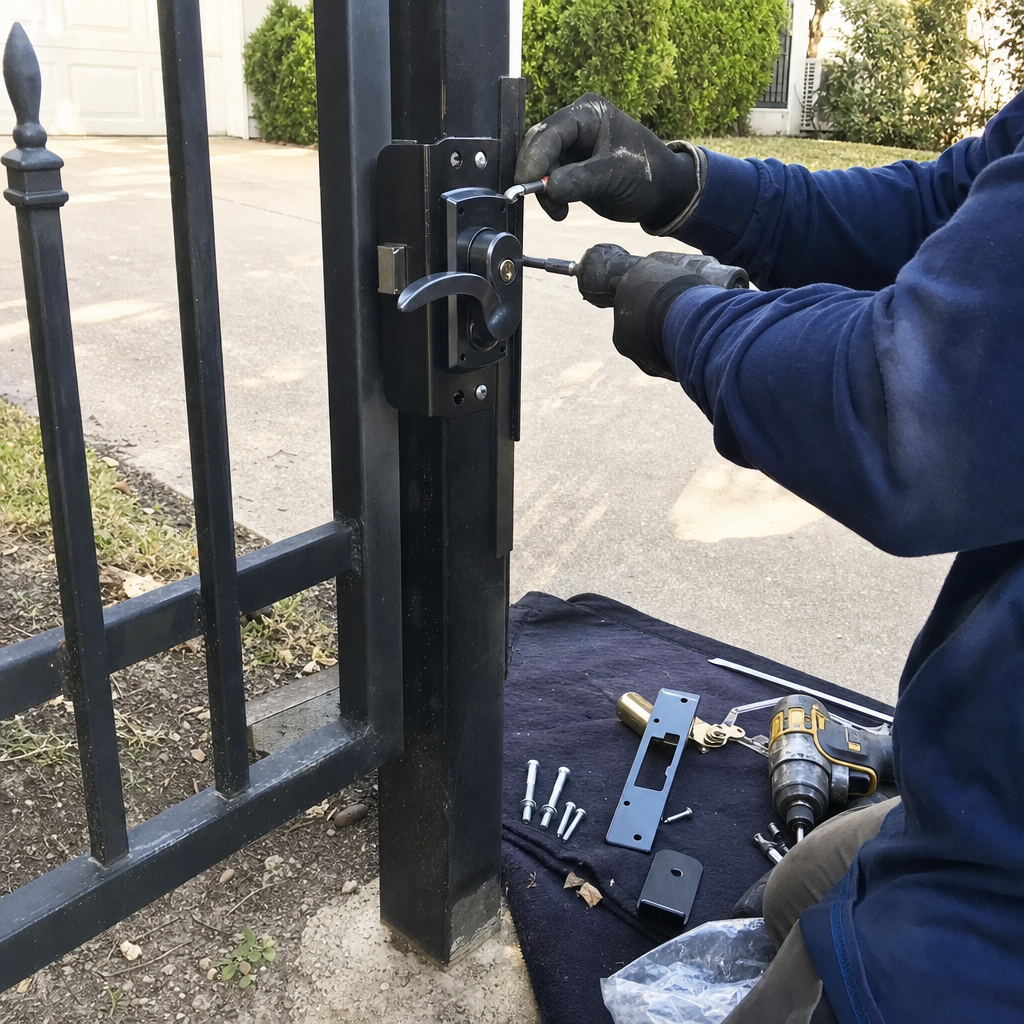
Ghost Controls Gate Repair Service in Dallas, TX | All Star Gate Repair Dallas
All Star Gate Repair Dallas provides independent Ghost Controls gate repair, motor service, and system diagnostics across Dallas — covering ZIP codes 75201, 75202, and well beyond. As an independent service provider with no affiliation to Ghost Controls, our recommendations are driven entirely by what actually fixes your gate. Jason Robinson and our team have accumulated 16 years of hands-on gate-system experience, including deep field familiarity with the specific low-voltage behaviors and actuator quirks built into Ghost Controls’ DC motor platform. Call (940) 326-5404 for a free estimate.
Why Trust All Star Gate Repair Dallas for Your Ghost Controls Gate Repair?
Ghost Controls systems are genuinely well-engineered — but they have their own personality, and that personality only reveals itself after you’ve diagnosed a few dozen of them. The TDS2’s control board, for example, doesn’t fail loudly. It drifts. Erratic open/close cycles come first, then the remote goes silent while the app keeps working, and most technicians who aren’t familiar with the platform either replace the board unnecessarily or misread the symptom entirely as a receiver fault.
Jason Robinson, our Owner and Lead Technician, built his foundational electrical and mechanical knowledge at Brookhaven College — including hands-on hydraulics coursework that pointed him toward automated gate systems before Ghost Controls existed as a brand. Over 16 years of exclusive gate work in the Dallas area, he’s logged field time on every major Ghost Controls model line and knows where these systems fail under North Texas conditions specifically. That matters here, because Dallas heat and clay soil create failure patterns that Ghost Controls’ own generic support documentation simply doesn’t cover.
We use OEM-equivalent parts from established gate-hardware distributors — not generic marketplace substitutes — and we service Ghost Controls in a way that protects your existing warranty. Our 343 verified reviews averaging 4.9 stars reflect that approach: fix it right, explain what happened, don’t sell what isn’t needed.
Common Ghost Controls Gate Repair Problems We Fix in Dallas
- Control board brownout on TDS2 and TSS1 units. This is the most misdiagnosed Ghost Controls failure we see in Dallas. The symptom — erratic open/close cycles followed by total unresponsiveness to remote commands — points most technicians toward the receiver. The actual culprit is almost always an undersized or aging 12V battery bank that can no longer hold voltage under load. Dallas summers push outdoor temps high enough to accelerate battery degradation significantly, and once the bank drops below the board’s minimum operating threshold, the logic controller starts misfiring before it shuts down completely. We load-test the battery bank first, every time.
- Actuator arm end-cap cracking on AXS1 and AXDS2 models. The end-cap is the plastic collar that locks the actuator arm to the gate bracket. On AXS1 and AXDS2 units, this component is particularly vulnerable to Dallas’s thermal expansion cycles — the bracket heats and expands through the summer, stresses the cap, and by fall the fit is loose enough that the arm slips the bracket mid-swing and leaves the gate frozen at 45 degrees. A cracked end-cap is a parts repair, not a full actuator replacement, and we stock these components on the truck.
- Solar charge controller miscalibration during North Texas winter fronts. The AXDS2 is Ghost Controls’ solar-ready dual-swing model, and it’s popular in Dallas for properties where running conduit to a post is expensive. The problem is that extended cloud cover — common during the multi-day cold fronts that roll through Dallas between November and March — can push the solar charge controller out of calibration, triggering low-battery fault codes even when the panel and battery are both functional. The controller reads a stale charge state and won’t clear it without a manual reset sequence. We’ve seen this misdiagnosed as a failed panel or a dead battery on more than a few service calls.
- Limit-switch drift on TSS1 and TDS2 actuators. This is the failure mode that generates the most repeat callbacks across Dallas — and it’s usually because the first technician replaced the control board without resetting the travel limits. The limit-switch potentiometers on Ghost Controls actuators drift over time, particularly after two-plus years of Dallas temperature cycling between summer highs and winter freeze events. A drifted limit pot causes the gate to reverse before reaching full open, or to over-travel and strain the hinge weld at the closed position. Fixing this means resetting the pot, not swapping the board.
- Gate post heave and hinge misalignment triggering false obstruction faults. Dallas sits on expansive black clay soil that swells with moisture and contracts sharply during drought. In the 75201–75202 corridor and along the Trinity River Greenbelt — where properties back up to the clay-rich floodplain — posts set in shallow footings can shift several degrees out of plumb over a single wet winter. When a Ghost Controls gate’s hinge line tilts even a few degrees, the built-in obstruction logic reads the increased actuator strain as a blocked gate and reverses the cycle. The fix isn’t a software reset. It’s post realignment, which is why Dallas Ghost Controls repairs almost always involve mechanical gate work alongside the electronics.
Ghost Controls Parts & Our Repair-vs-Replace Approach
We stock OEM-equivalent Ghost Controls actuator arms, control boards, battery trays, and end-cap hardware sourced directly from established gate-hardware distributors — the same supply chain the brand draws from. We don’t pull parts off generic online marketplaces, because compatibility tolerances on Ghost Controls actuators are tighter than they look, and an off-spec arm can introduce the same limit-drift problems you were trying to solve.
On the repair-versus-replace question, we give you an honest number comparison. When an AXS1 actuator motor has failed internally, the labor cost to rebuild the arm often approaches the cost of a replacement unit — at that point, a new arm makes more economic sense, and we’ll tell you that plainly. On a TDS2 or TSS1 with a drifted limit pot and a degraded battery bank, full replacement almost never makes sense; those are serviceable components at a fraction of the system cost.
The decision is always yours. We lay out both options with real numbers. Call (940) 326-5404 and we’ll walk through it before anyone turns a wrench.
Our Ghost Controls Service Process — Step by Step
- 1
Diagnostic assessment. We start with a full system read — battery bank load test, control board voltage check, actuator travel cycle, limit-pot position, and physical gate alignment. On Ghost Controls systems, we never assume a board failure until the battery bank is ruled out, because a brownout board and a dead board look identical on first inspection.
- 2
Root-cause repair. We fix the actual problem, not just the presenting symptom. If the limit pots have drifted on a TDS2, we reset them. If the gate post has heaved out of plumb and is triggering obstruction faults, we realign the post. If the end-cap on an AXS1 arm is cracked, we replace the cap — not the whole actuator, unless the motor itself has failed.
- 3
System test under load. After repair, we run full open and close cycles, confirm travel limit accuracy at both endpoints, verify remote and app responsiveness, and check solar charge status on AXDS2 installations. We don’t leave the driveway until the gate cycles cleanly under real operating conditions.
- 4
Warranty documentation. As an independent Ghost Controls service provider, we document all parts installed and work performed so you have a clear service record. We work in a manner designed to protect your existing product warranty, and we’ll flag any condition that could affect your coverage before we proceed.
Ghost Controls Products We Service & Install in Dallas
We service and install the full current Ghost Controls actuator lineup, including:
- Ghost Controls TDS2 — Heavy-duty dual-swing gate opener; our most common service call in North Dallas residential and HOA applications
- Ghost Controls TSS1 — Heavy-duty single-swing gate opener; frequent in Arts District and Harwood District residential properties
- Ghost Controls AXS1 — Single-swing opener; common on mid-weight residential gates, including older properties in the Bishop Arts District
- Ghost Controls AXDS2 — Dual-swing, solar-ready; increasingly specified on properties where conduit runs are cost-prohibitive
We carry actuator arms, control boards, battery trays, and end-cap hardware locally for fast turnaround on the most common repair jobs — no waiting on a mail-order part to restart your service call.
We Also Service These Brands
Ghost Controls expertise is one piece of a broader capability. All Star Gate Repair Dallas also services LiftMaster, FAAC, BFT, and Linear gate systems, along with Viking, DoorKing, Elite, and Mighty Mule. Whether your property runs a Ghost Controls actuator on the residential gate and a FAAC operator on a commercial entry, we can service both on the same visit. Gate specialists, not generalists.
FAQs — Ghost Controls Gate Repair Service in Dallas
No — we are an independent Ghost Controls service provider with no affiliation with or endorsement by Ghost Controls or its parent company. That independence is intentional. Our job recommendations are based on what actually solves the problem, not on any manufacturer relationship. We’ve accumulated our Ghost Controls expertise through 16 years of field diagnostics on these specific systems across Dallas, not through a factory certification program.
On the TDS2, the most common cause is limit-switch potentiometer drift — the travel-limit settings have shifted from their calibrated position, so the actuator thinks the gate has reached full open before it actually has and triggers a reversal. This gets worse after Dallas’s seasonal temperature swings, which cause the actuator housing to expand and contract enough to move the pot over time. A secondary cause is gate-post misalignment: if the post has heaved even slightly in the clay soil, the actuator reads the increased resistance as an obstruction and reverses. Both are field-repairable. Call (940) 326-5404 and we can usually tell you which scenario fits your symptoms before we arrive.
When the app responds but the RF remote doesn’t, the radio receiver is almost certainly the issue — not the control board and not the motor. Ghost Controls systems use a separate receiver module for RF commands, and that module can fail independently while the Wi-Fi-connected board logic continues working normally. In Dallas, heat-related solder fatigue on the receiver board is a common culprit, especially on units installed in direct sun exposure. This is a component-level repair, not a full system replacement. Call (940) 326-5404 for an accurate diagnosis.
Yes, with some realistic expectations. Dallas gets strong solar hours through the summer, which suits the Ghost Controls solar platform well. The challenge is winter: extended overcast periods during North Texas cold fronts can run the battery bank low enough that the charge controller loses calibration and throws low-battery faults even after the sun returns. On solar-equipped installations, we recommend an annual pre-winter battery load test and charge controller check. Properties along the Trinity River Greenbelt, where gate posts already deal with extreme clay-soil movement, should factor in both the solar maintenance cycle and a post-alignment check each spring.
Almost certainly not. A loose or snapped arm connection is most often an end-cap failure — the plastic collar that locks the arm to the gate bracket cracks under Dallas’s thermal expansion cycles, the arm works loose, and the gate stalls mid-swing. The actuator motor itself is typically undamaged. We stock end-cap hardware and OEM-equivalent arms on the truck, so this is usually a same-visit repair. If the motor has also been strained from repeated stall cycles, we’ll tell you before assuming it needs replacement. Call (940) 326-5404 for a straight answer.
Ghost Controls repair costs in Dallas typically range from $95–$175 for a diagnostic service call with minor adjustments (limit reset, connection tightening, charge controller recalibration), $175–$350 for component-level repairs such as battery replacement, receiver board swap, or end-cap and arm replacement, and $350–$650+ for actuator replacement combined with post realignment — a common pairing on Dallas properties where clay-soil heave has both shifted the post and strained the motor. These ranges reflect Dallas-area market rates for an independent specialist with parts on hand; final cost depends on your specific model and site conditions. Call (940) 326-5404 for a free estimate — we’ll give you a number before we start.
We stock the components that break most often on Ghost Controls systems in Dallas: actuator arms, control boards, battery trays, end-cap hardware, and receiver modules for the TDS2, TSS1, AXS1, and AXDS2 lines. Most Ghost Controls repairs in the Dallas area are completed on the first visit without waiting on a parts shipment. Less common components — specific solar charge controllers, for example — may require a short lead time, but we’ll confirm availability before scheduling so there are no surprises on arrival.
Book Your Ghost Controls Service in Dallas, TX
If your Ghost Controls gate is reversing early, ignoring the remote, or sitting stuck mid-swing, the next step is a real diagnosis — not a parts-swap guess. Call All Star Gate Repair Dallas at (940) 326-5404 to schedule your free estimate. Jason Robinson and our team are ready to take your call and, as Jason puts it: “Tell me what it’s doing — or not doing — and I can usually tell you what’s wrong before I pull into your driveway.”
Reviewed by Jason Robinson, Owner & Lead Technician at All Star Gate Repair Dallas, serving Dallas, TX and the surrounding North Texas area for 16 years.